
Appearance
10. Transformation Strategies (R-ARSED)
When a BUMP enters the PTO engine, you must consciously select a Transformation strategy. These strategies represent the application of Agency.
The mathematician and systems theorist Russell Ackoff fundamentally argued that our survival is dependent on our ability to transform the problems we face, in the age we face them, using the tools we have available to us at that time. Bumponomics formalizes this into 6 distinct intervention levers, remembered by the provocative acronym R-ARSED.
1. The R-ARSED Transformation Palette
Depending on the scale of the problem and your available systemic energy, you must choose one of the following six distinct paths:
| Play | The Action | Energy Requirement | Time Horizon | System Impact |
|---|---|---|---|---|
| Absolving | Ignore | Low (Withdrawal) | Immediate | Problem persists safely; energy conserved. |
| Resolving | Patch | Medium (Repeated) | Short to Medium | Problem is suppressed but stays in orbit. |
| Solving | Optimize | High (Analytical) | Medium to Long | Problem is eliminated by removing the root cause. |
| Evolving | Transcend | Medium (Adaptive) | Long-term | Problem is absorbed as fuel to mature the system. |
| Dissolving | Redesign | High (Upfront) | Permanent | Problem becomes impossible due to a new environment. |
| Revolving | Exploit | High (Ongoing) | Indefinite | Problem is intentionally kept alive for profit or power. |
2. Deep Dive: The Mechanics of Transformation
Absolving (A)
- Diagnostic: Is this problem worth my energy at all?
- The Mindset: Absolving is the conscious decision to withdraw effort or intervention. It is not laziness; it is a strategic calculation of proportionality. You simply let it be.
- The Result: The problem persists, but it is no longer allowed to consume decision capacity.
Resolving (R)
- Diagnostic: Can this be fixed within the current system?
- The Mindset: Resolving assumes the system is fundamentally sound, but a localized component is broken. You apply a known "patch" or best practice to restore normal operation.
- The Result: The problem disappears temporarily but is likely to recur if structural conditions change.
Solving (S)
- Diagnostic: Can the root cause be surgically removed?
- The Mindset: Solving is a clinical, diagnostic approach. You hunt down the specific defect causing the friction and eliminate it entirely, returning the system to its ideal state.
- The Result: The specific problem is neutralized permanently.
Dissolving (D)
- Diagnostic: What must we redesign so this problem could no longer logically exist?
- The Mindset: Dissolving does not fight the problem; it changes the game. You completely redesign the environment, the rules, or the system architecture so the conditions that previously bred the problem vanish.
- The Result: The problem disappears because the world in which it existed is gone (e.g., streaming dissolved the problem of physical DVD scratches).
Evolving (E)
- Diagnostic: Is this problem actually a catalyst for growth?
- The Mindset: Evolving treats the friction not as a defect, but as fuel for learning. The system grows through the problem, maturing into a new state of being. The problem transforms us, and we transform the problem until it is an integrated, essential feature of our new identity.
- The Result: The system transcends the friction entirely.
Revolving (R) [The Antagonist Strategy]
- Diagnostic: Who benefits if this problem never ends?
- The Mindset: Revolving is the deliberate act of keeping a problem in circulation because its continued existence creates power, funding, or control. The problem is not a bug; it's a feature.
- The Result: The problem persists indefinitely, draining energy from the vulnerable to feed the orchestrator.
3. The Politics of Problems: "WHO'S ARSED?"
Transformations do not happen in a vacuum. A problem often persists because it is, in fact, a solution for someone else. To understand why a BUMP isn't shifting, we must look at the human incentives using the "WHO'S" prefix.
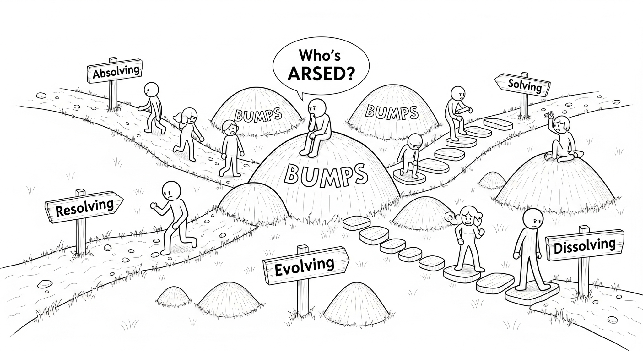
This introduces the critical dimension of political empathy and structural power:
- W - Weaponizing: Who actively uses this problem as a tool for leverage, budget negotiation, or control?
- H - Hindering: Who actively blocks genuine solutions because their authority is tied to the manual, broken procedure?
- O - Orchestrating: Who is the puppet master ensuring the problem's survival conditions remain perfectly aligned?
- S - Struggling: Who is actually paying the price? Who is bearing the human, financial, and emotional load of this friction?
By mapping the WHO against the R-ARSED transformations, you immediately expose whether an organization lacks the competence to Solve a problem, or whether a bad actor is quietly Revolving it.